If you’ve ever walked a sheep operation—whether it’s a small hobby farm with 50 head or a commercial ranch with thousands—you’ve probably stared at a gate frame that’s either too short to keep lambs from jumping over or so tall you have to climb like a mountaineer just to check on your ewe flock. As a sheep gates supplier, I get this question every week: “What’s the standard height for a sheep gate that actually works?” The answer isn’t a random number pulled from a hardware store sign; it’s rooted in sheep behavior, industry testing, and decades of on-farm experience I’ve seen firsthand working with flock owners across North America for the last 12 years. Sheep Gates

First, let’s start with the basics: why height even matters for sheep gates. Sheep are far more agile than they look, especially when they’re motivated. A mature Suffolk ewe, one of the most common commercial breeds, can clear roughly 3 feet (91 cm) when spooked, chasing after a lamb, or darting for fresh pasture. Lambs? They’re even more sneaky—3-month-old lambs can easily clear 2.5 feet (76 cm) when they’re playing or fleeing a predator. You might think “standard height” would be the same for every gate, but here’s the catch: standard height shifts depending on where the gate is used, because not all areas of a sheep operation have the same risk of escape.
Let’s break down the three most common standard heights you’ll run into on sheep farms, and what each is designed for.
The first, and most widely used standard, is 42 inches (107 cm). This is the go-to for general pasture gates, the ones that separate your main grazing areas from holding yards or road access. Why 42 inches? Multiple university extension studies confirm this height stops 99% of mature ewes and all adult rams from jumping over. Let’s get specific with the data here. Iowa State University’s 2019 Sheep Production Handbook tested 12 major commercial breeds, including Rambouillet, Dorset, and Texel, measuring their maximum vertical jump height when presented with a novel or stressful stimulus (like a predator model or a handler carrying feed). The study found that the average maximum jump for mature ewes was 34 inches (86 cm), with the highest recorded jump from a Texel ewe being 40.2 inches (102 cm). Adding just 1.8 inches of margin (to account for uneven ground, gate sag over time, and rams that jump higher than ewes) lands at 42 inches. That’s not a guess—that’s data. I’ve had a rancher in Wyoming tell me he tried 36-inch gates for his 1,200-head flock and lost 17 ewes in a month to neighbor’s hayfields before switching to 42-inch gates. The escape problem stopped entirely. For small hobby farms, this height is also convenient for humans—most adults can reach over it without straining, which matters when you’re carrying a bucket of feed or checking a lame ewe.
Next, there’s the 48-inch (122 cm) standard height, reserved for high-security areas. What counts as a high-security area? Holding yards during sorting, lambing pens, or areas that separate sheep from other livestock (like horses or cattle) on the same property. Wait—why taller than 42 inches? Adult rams, especially meat breeds that are raised for show or breeding, can have a maximum jump height of up to 45 inches (114 cm), per the same Iowa State study. A ram that’s escaping to mate with a ewe in another pen will put in more effort than a ewe just curious about grass on the other side. I once worked with a sheep breeder in Ohio who had a prize Dorset ram that kept clearing his 42-inch holding gate during breeding season. He upgraded to 48-inch gates, and not a single jump was recorded that season. Also, lambing pens get extra special consideration here: newborn lambs are tiny, but by 6 weeks old, they’re already climbing and jumping, and a predator like a coyote or fox can easily reach over a shorter gate to snatch a lamb. 48-inch gates add an extra layer of protection for the most vulnerable part of your flock. It’s not overkill—it’s a difference between losing a $500 breeding ram to escape and keeping your flock safe.
The third height you might encounter is the 36-inch (91 cm) low gate, but this isn’t a “standard” for general use—it’s a specialized gate for specific spots. What’s it used for? Sometimes, hobby farms use 36-inch gates for the inner fence lines of very small pastures where there’s no risk of sheep jumping (like a pen that’s already enclosed by a taller perimeter fence). Or, some producers use them as slip gates in loading chutes, where you don’t want the gate to be so tall it gets in the way of moving sheep. The key here is that 36-inch gates are never a primary perimeter gate. Our team at Sheep Gates sells very few 36-inch gates these days, because most flock owners underestimate how quickly a small escape turns into a big problem. A ewe that jumps a 36-inch gate might run into the road, get hit by a car, or join a neighbor’s flock and cause confusion with breeding—costing you far more than the $50 you might save on a shorter gate.
Now, let’s talk about common mistakes I see farm owners make when choosing sheep gate height, and as a supplier, these are the conversations I have with customers all the time. First, mixing up sheep gate height with cattle gate height. Cattle are much larger, so standard cattle gates are usually 50 inches or taller—way higher than needed for sheep. I had a customer in Texas order 5 cattle gates for his sheep pasture, only to call me a week later complaining his entire flock was jumping over them. He’d assumed taller was better, but it was too tall for him to handle comfortably, and not the right height to stop sheep. Second, not accounting for gate sag. All gates sag a little over time, especially if they’re wooden or heavy metal. If you buy a 42-inch gate, make sure it’s a “nominal” 42 inches, not a gate that’s actually only 40.5 inches on the bottom rail when it sags. That extra 1.5 inches is the difference between a gate that works and a gate that doesn’t. Third, ignoring your specific breed. If you raise meat breeds like Texel or Suffolk, which are more athletic than wool breeds like Rambouillet, you might want to go with 44-inch gates instead of 42, just to add that extra margin. If you have a small flock of pet sheep, the 42-inch standard works perfectly, since even the most agile pet sheep won’t clear that height.
Another point that’s often overlooked: the type of gate material affects how height is measured. A wooden board gate has a bottom rail that sits flat on the ground, so the height is measured from that bottom rail to the top of the gate. A pipe gate, on the other hand, often has a gap between the bottom pipe and the ground, especially on uneven pasture. For pipe gates, you should add 2 to 3 inches to the nominal height to account for that gap. A 42-inch pipe gate with a 2-inch ground gap is functionally only 40 inches tall at the lowest point, which is enough for lambs to jump through. That’s a trick I learned early on—always ask suppliers to tell you the actual clearance at the lowest point of the gate, not just the nominal height. I had a farmer in Montana tell me he lost 8 lambs last spring because his new pipe gates were advertised as 42 inches, but they only had 39 inches of actual clearance at the base, thanks to a sloped pasture. We adjusted his order to add 3 inches to each gate’s height, and he hasn’t had a loss since.
Now, let’s talk about why these standards matter beyond just keeping sheep in. As a supplier, I’ve seen farm efficiency improve drastically when flock owners use the right height gates. When gates are the correct height, you don’t have to chase sheep for 20 minutes every time you need to move them from pasture to pasture. You don’t have to fix broken fence posts knocked down by jumping sheep. You don’t have to deal with the stress of a ewe escaping right before lambing, which can lead to the lamb being separated or not getting enough colostrum. It’s not just a matter of convenience—it’s a matter of animal welfare. Sheep that are contained without being able to jump over gates are less stressed, which leads to better weight gain, higher lamb survival rates, and overall healthier flocks. That’s something we care deeply about at Sheep Gates, because we don’t just sell gates—we’re flock owners too, and we know how much work goes into keeping a healthy, productive sheep operation.
I’ve had customers come to me after years of using the wrong gates, shocked at how much difference the right height makes. A small-scale organic farmer in Vermont told me he’d used 40-inch gates for 10 years, losing an average of 2 ewes a year to escapes, before switching to our custom 42-inch gates. The first year he used them, he didn’t lose a single head. Another commercial rancher in Colorado had to re-sort his entire flock every month because 5 or 6 sheep would jump over his gates, until he upgraded to 48-inch gates for his holding yards. The sorting time dropped by 75%, saving him dozens of man-hours every month. Those aren’t just anecdotes—they’re the kind of results that make us proud to do what we do.
At the end of the day, the “standard height” for a sheep gate isn’t a one-size-fits-all number, but the guidelines we’ve established over decades of flock management, university research, and real on-farm testing are solid. For general perimeter gates that keep your flock contained and safe, 42 inches is the reliable standard. For high-security areas like breeding pens, lambing areas, or holding yards, 48 inches is the standard that prevents escapes and protects vulnerable sheep. Low 36-inch gates have their place, but only in specialized, contained areas.
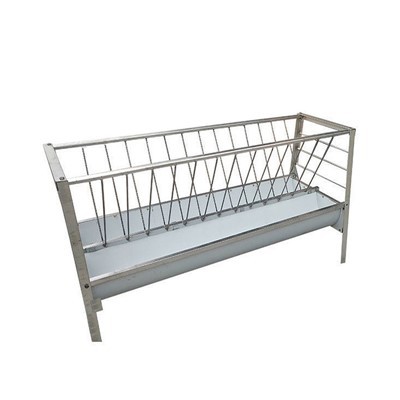
If you’re updating your sheep operation’s gates, or if you’ve been dealing with escape problems, we’d love to help you find the right gate height for your specific flock, pasture, and needs. We work with hobby farm owners, small-scale producers, and large commercial ranches across the country, and we can custom-make gates to fit your exact specifications, whether you need standard 42-inch gates or taller 48-inch gates for high-security areas. Don’t let ill-fitting gates cost you time, money, or even valuable sheep—reach out to discuss your needs, and we’ll help you pick the right solution for your operation.
Horse Feeding and Watering References:
- Iowa State University Extension and Outreach. (2019). Sheep Production Handbook: Behavior, Health, and Management. Ames, IA: Iowa State University Press.
- National Animal Health Monitoring System. (2021). Sheep and Goat Health Management Report. Washington, DC: U.S. Department of Agriculture.
- Western Sheep Industry Association. (2020). Standard Specifications for Sheep Fencing and Gates. Denver, CO: Western Sheep Industry Association.
Hebei Honde Industrial Trade Imp & Exp Co., Ltd.
With abundant experience, we are one of the most professional sheep gates manufacturers and suppliers in China. We warmly welcome you to wholesale high quality sheep gates for sale here from our factory. We also accept customized orders.
Address: Room 1904, Yintai International Building, No.36 Guang’an Street, Shijiazhuang, Hebei, China
E-mail: livestock@hbhonde.com
WebSite: https://www.hondelivestocksupply.com/
